How Klima Protocol Incentives Are Calculated

Klima Protocol's intention is to build an open-source, non-extractive system for the carbon markets: one that gives project developers efficient distribution to the market, and lets buyers access and execute against real-time carbon pricing without uncertainty about what they are sourcing or how.
Incentives are a core part of how that works. They encourage the participant input that shapes which carbon credits the protocol interacts with, and they are the mechanism by which any value created is distributed to the people who help shape the system. This piece is a deeper dive into that mechanism: how the rates are arrived at, why they vary the way they do, and what that variability says about how the protocol handles the difference between carbon coming in and carbon going out.
Where a rate comes from
Incentives go to participants who stake, and how much a stake earns depends on the duration chosen; live rates are shown in the app. What is less obvious is that the incentive curve is itself dynamic. Its shape changes from week to week, and the duration carrying the highest incentive today may not be the one carrying it tomorrow, let alone in six months.
In the protocol's first days the strongest accrual sat on one of the nearer maturities. Within weeks it had moved a long way further out, and it has kept moving since. That is the mechanism doing its job rather than a fault in it, and it is reasonably easy to follow once the shape of the calculation is clear. Broadly: if more participants stake on near-term durations the curve tightens and the peak moves closer; if they stake for longer, it stretches back out.
Defining value
Klima issues kVCM when carbon is supplied into the protocol and burns kVCM when carbon is retired out of it. Those flows never net cleanly against one another: supply and retirement arrive at different times, in different volumes, across different carbon classes, at execution rates that reflect what participants have signalled about each class. A difference opens up between the two, and every market has to answer the question of who receives it.
In a market organised around intermediation, the answer is whoever stands in the middle. The gap between what a supplier is paid and what a buyer pays becomes margin, and the more friction there is to monetise, the wider that gap can be held open. None of this requires bad behaviour on anyone's part: it is what the structure rewards, and it is part of why reducing friction has historically been in the interest of suppliers and buyers but not of the parties best placed to reduce it.
Klima answers the same question differently. Any difference between the kVCM issued in connection with carbon intake and the kVCM burned in connection with retirement is reflected solely as a change in the circulating supply of kVCM. No margin, profit, or financial surplus is retained or extracted by any entity. There is no treasury taking a share, no privileged market maker, and no procurement desk with a mandate to optimise; the difference resolves into the supply and stops there.
That is what non-extractive means here. It is a statement about where value can and cannot go, rather than about anyone's intentions, and it is the reason the rest of this piece is about proportions rather than payments.
What staking is for
The protocol needs two things to be true continuously, and it issues tokens to the participants who make them true.
The first is a credible signal about the execution rate for a given group of carbon credits. A participant who stakes kVCM does so until a maturity, or unlock date, set in ninety-day increments, and allocates that stake across the protocol's carbon classes. Aggregated across everyone, those allocations inform the rate at which the protocol issues kVCM when suppliers deliver credits into a class, and burns it when buyers retire from one. Staking kVCM and allocating it to a class turns a view about what that class should be worth into an execution rate that other participants, namely carbon buyers and suppliers, transact against.
The second is capacity, which is a separate question from price. Carbon classes differ in how much activity they can absorb before their terms begin to move, and a class that prices well but cannot take size is of limited use to a buyer with a real retirement obligation. Participants express a view on this by staking K2 for a short duration and allocating it across classes. A class carrying more K2 becomes less sensitive to intake and retirement activity.
Why the rate varies with duration
Incentives are not spread evenly across the available durations. The protocol builds a curve across them, and the curve has a peak: some duration carries the strongest accrual, with rates falling away either side of it. Choosing a longer duration is not simply better, and neither is choosing a shorter one.
What sets the position of that peak is the distribution of everyone else's stakes. The curve is derived from the average duration currently staked across the protocol, so it reflects where participants have actually chosen to sit rather than a schedule fixed in advance. When most stakes are short, the peak sits close in; as the average lengthens, the peak moves out with it.
That movement is visible in the protocol's own record. At the end of February, in the protocol's first week, the strongest accrual sat a year or so out, with the nearer slots close behind it and everything beyond falling away sharply. Read again on 19 August 2026, the peak sits a couple of years further out, and the ladder has filled out with it: a handful of maturities carried any stake at all in February, and noticeably more do now, with meaningful accrual reaching several years ahead. The number carrying stake can fall as well as rise, because these are fixed calendar slots rather than durations: a maturity drops out of the count once it falls due. Participants staked for longer, and the curve followed them.
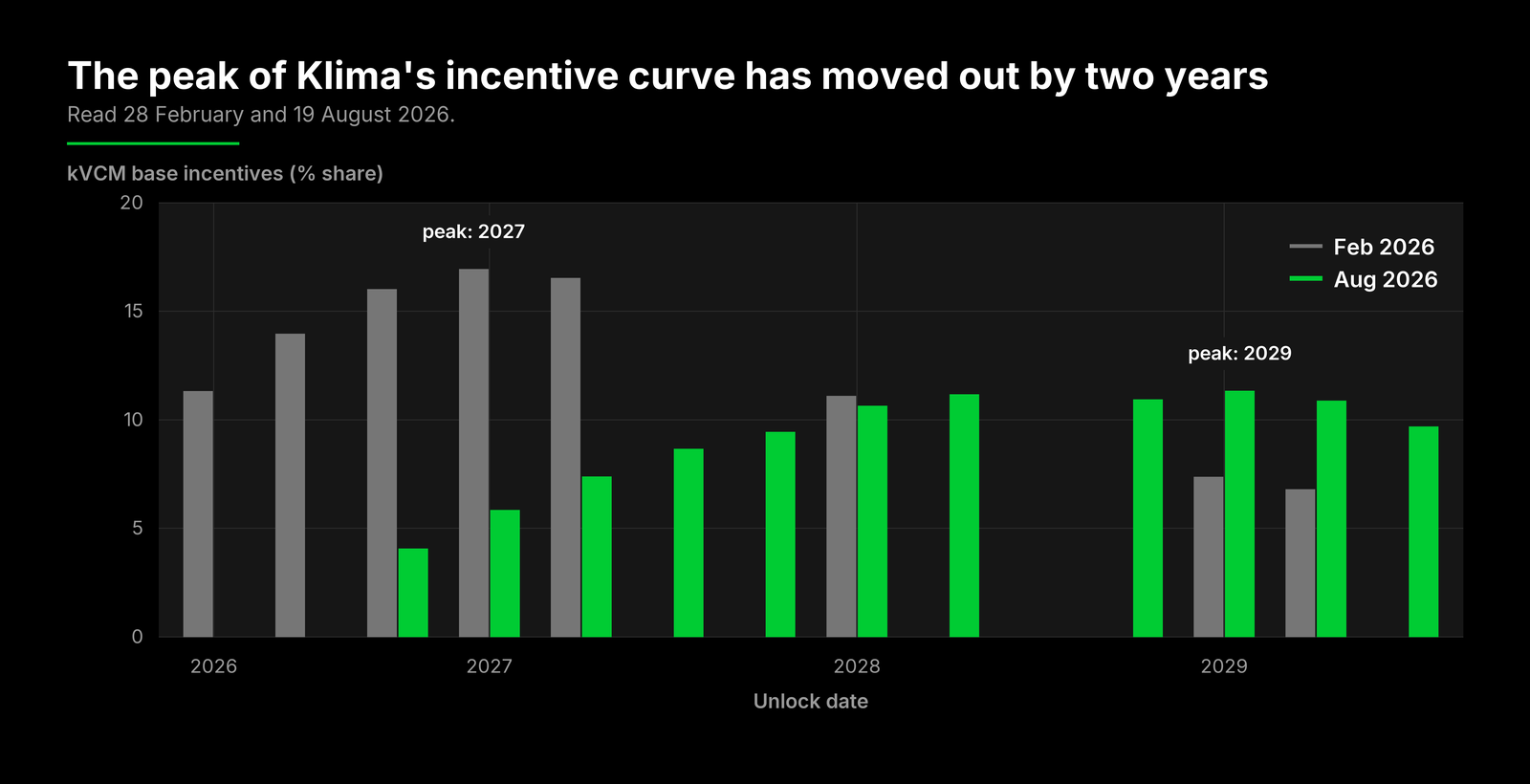
The gaps in that picture are worth reading correctly. A maturity with no bar is one nobody has staked into, not one the protocol declines to reward. Accrual is a rate applied to whatever sits at each maturity, so an empty one produces nothing simply because there is nothing for the rate to act on, and nothing is issued in its place. A few lone locks fall due in 2030 and beyond and are left out of the chart, which would otherwise stretch a long way for very little: they earn like any other stake, but they say little about where the market has settled. Every maturity on the ladder carries a positive rate, including the furthest out, where accrual tapers steadily without ever reaching zero. There is a quiet consequence to supply left unstaked: base accrual scales inversely with the proportion of supply committed, so the maturities nobody has chosen leave the rate slightly higher for everyone who has.
The effect is a gentle pull toward the middle of wherever the market has settled, and away from crowding at any one point on the curve.
Why the rate varies over time
The same logic governs how issuance is divided between the functions the protocol needs performed, the two signals above among them. Incentives are apportioned according to how much of the outstanding supply currently sits behind each one, and those proportions are live: every stake opened, every maturity reached, changes them, and the split recalculates.
The relationship is not linear. As one function becomes crowded relative to the others, its share of issuance falls away more sharply than its growth in size alone would suggest, and the shares flowing elsewhere rise to meet it. The protocol leans against its own concentration, steering issuance toward whichever function is currently thin, without anyone deciding that it should.
So a rate is a statement about the system rather than about the participant holding it. It moved because other people's stakes moved. Someone staking into a function nobody else is serving is compensated more heavily for as long as that remains true, which is the behaviour you would want from a mechanism designed to keep a market balanced.
Visible, but set by no one
The tokens coordinate participation in market infrastructure: kVCM as the unit of account for intake and retirement, K2 as a signal about capacity. Incentives are issued programmatically under rules published in the whitepaper, applied identically to every participant, and verifiable onchain.
Taken together, this is a system in which the rates are visible but not fixed, and in which nobody holds the discretion to set them. That includes the protocol, which follows the calculation, and it includes any participant, who cannot know what everyone else will do next. Understanding the rates therefore means understanding what makes them move, rather than memorising a number that will be different next quarter.
Why it is built this way
The questions that matter most in a carbon market are stubbornly subjective. Which classes should the market carry, at what relative weights, with how much capacity to absorb activity before terms move? These have no objectively correct answers, they change constantly, and somebody has to keep answering them. In the conventional market that work is done by procurement teams and broker relationships, often competently, but privately: the answers are not observable to the participants they affect, and the reasoning behind them is not something a buyer can inspect.
Klima answers them through staking instead. Staking tokens for a duration and allocating them to a class is an observable statement about what that class should be worth and how much of it the market should carry, and the protocol weights that statement by how much was staked and for how long. Directing issuance toward those participants is payment for performing a function the market requires and would otherwise buy from an intermediary. The whitepaper states the design intent directly: reduce opaque intermediation and hidden margins, without replacing them with a new rent-seeking intermediary.
Which brings the moving peak back into focus. A rate that shifts as the participant base shifts is a rate that is reporting on the market, and following it is a reasonable way to understand where the protocol currently needs support.
The parameters, formulas, and issuance curve are set out in full in the Klima Protocol whitepaper; the reasoning behind directing issuance this way is covered in Why Klima Protocol Uses Incentives.