Klima Hackathon: How Vealth Turns Proven Work Into Retired Carbon
The Klima Community Hackathon has a winner. Vealth, built by EcoWealth, is a platform that turns real-world ecological work into priced, provable tasks and attaches a verified carbon retirement to each one. It settles those retirements through Klima Protocol's Retirement Aggregator on Base, reached over the protocol's x402 endpoint, and its public beneficiary record on Carbonmark currently shows 199.04 tonnes retired across 605 separate retirement transactions. That record is still growing several days after the competition's retirement cutoff, which is precisely the outcome the hackathon was designed to select for.
Why the hackathon existed
Klima Protocol's infrastructure was built to make carbon retirement as easy, transparent, and scalable as the underlying market allows: no protocol fees on retirement, high throughput, instant settlement, and unobfuscated execution rates. Building that infrastructure and having it used are two different problems, and only the first one is solved by writing smart contracts. Retirement demand increasingly originates inside applications that Klima does not build and should not need to build: procurement tools, consumer products, agent frameworks, and treasury automations, each with its own users and its own reasons to compensate for emissions. Klima has developed the infrastructure; the hackathon's objective is about operationalising it.
The brief was deliberately narrow, and it followed two opportunity areas. The first is tapping into DeFi flows, which are orders of magnitude larger than the carbon markets; redirecting even a fraction of them could scale carbon market impact meaningfully. The second is Web3 abstraction: giving carbon market participants the benefits of blockchain settlement without exposing them to the complexities of interacting with the blockchain itself. An earlier internal hackathon had already produced several working use cases along those lines, including the x402 endpoint itself, an incentive-to-retire mechanic, market analytics tooling, and protocol insights driven by language models. Opening the same exercise to the community was the logical next step.
The tools entrants had to work with
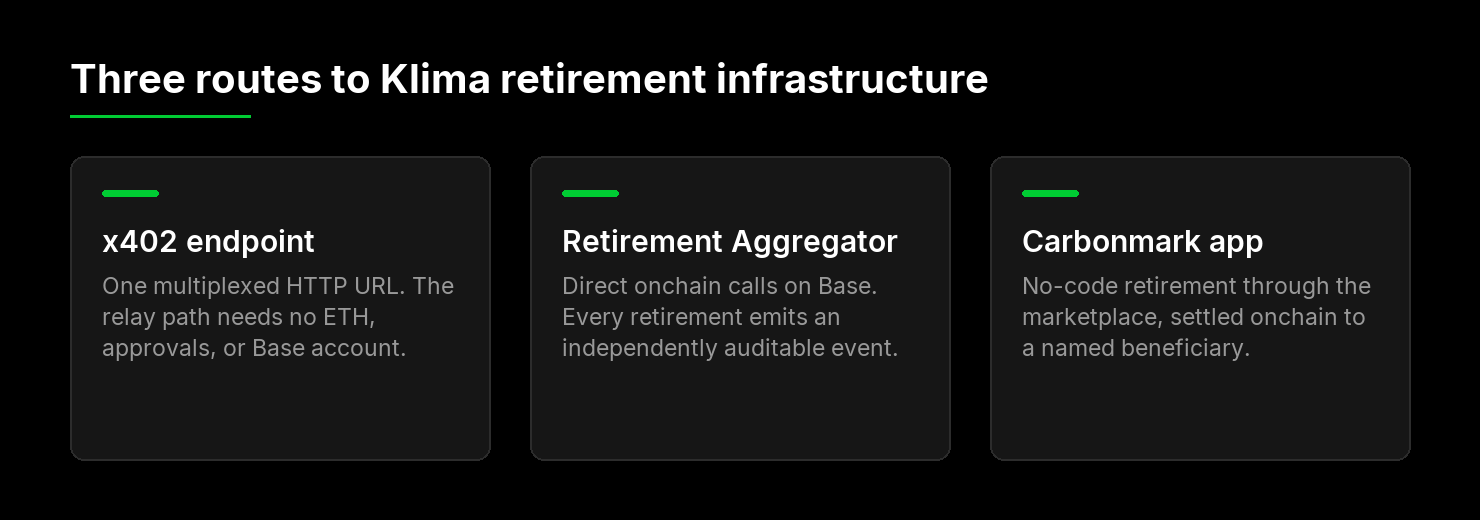
Entrants could reach Klima's retirement infrastructure by three routes, and the choice between them is a reasonable proxy for how much onchain machinery a team wanted to operate itself.
- The x402 endpoint. A single multiplexed URL at
x402.klimalabs.com/apiexposes six actions in front of the Retirement Aggregator: discover available carbon classes and credits with registry, vintage, and price metadata; quote a live onchain price for a given tonnage; prepare calldata and approval instructions for a self-submitted retirement; build an EIP-712 authorisation for a relayed one; relay a caller-signed authorisation onchain; and resolve the public Carbonmark certificate for a confirmed transaction. Reads are free. The service is non-custodial and never holds funds, since payment flows directly to the settlement contracts through signed authorisations (EIP-3009 for USDC, EIP-2612 for kVCM). It runs on Base mainnet and Base Sepolia, and publishes an agent-discovery manifest at/.well-known/x402.jsonso that x402 directories and agent crawlers can index it without being pointed at it. - The Retirement Aggregator contract directly. Teams already working onchain could call the aggregator on Base themselves, passing a
RetireDetailsstruct that names the beneficiary. Every successful retirement emits anAggregatorRetiredevent with both the retiring address and the beneficiary address indexed, so organisers, auditors, and competing teams could all verify the scoreboard independently by filtering the chain. - The Carbonmark app. For teams building offchain products that collect payment through conventional rails, the marketplace front end handles retirement without code, settling the result onchain to a named beneficiary.
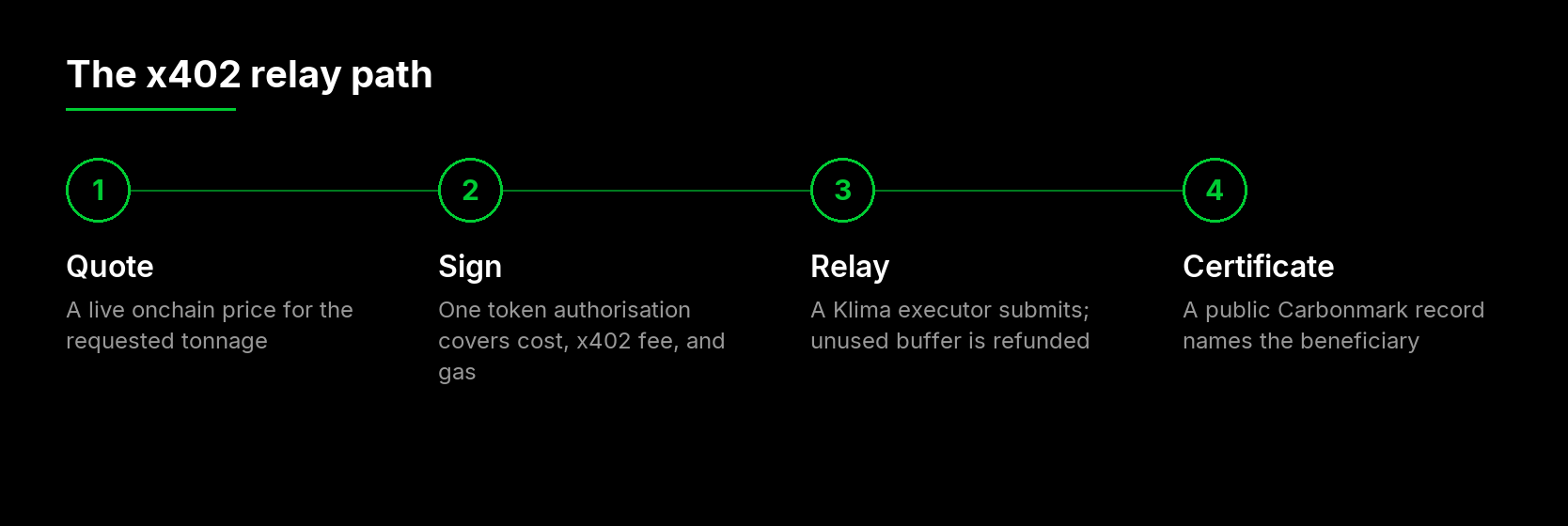
The relay path in the x402 endpoint deserves particular mention, because it is what makes the endpoint usable by developers who are not crypto-native. A caller signs one standard token authorisation covering the retirement cost, the x402 fee, and a gas reimbursement, all slippage-buffered; a Klima executor submits the transaction and is reimbursed from that signed budget, with unused buffer refunded in the same transaction. The signer needs a USDC or kVCM balance and nothing else: no ETH for gas, no prior approvals, no Base account to fund and monitor. For a hackathon with a four-week clock, removing wallet infrastructure from the critical path is the difference between shipping and not shipping.
What Vealth built
Vealth is a marketplace for provable ecological work. In their words:
"Most ecological work has value regardless of whether it produces a carbon credit. Restoring habitat, improving water systems, planting shade trees, increasing building efficiency, or improving food systems are worthwhile because the work itself benefits communities and ecosystems.
When that verified work also produces measurable carbon benefits, Klima becomes the ideal complementary settlement layer. Carbon retirement is attached as an environmental receipt generated by completed work—not as the reason the work exists.
We believe this strengthens voluntary carbon markets by connecting them to a much larger universe of ecological work that is already needed across the world."
At a technical level, Vealth exposes its own surfaces as keyless paid calls, priced from a cent, so that someone can tap once in a wallet and an agent calls the identical URL with no account and no subscription. One of those surfaces maps a type of work to its tCO2eq estimate and its retirement lane, using the same mapping that settlement uses. Another, retire-attach, takes a single paid call and executes a real retirement through Klima's Retirement Aggregator on Base via x402, attributed onchain to whichever address the caller names, returning the transaction hash and the caller's own public Carbonmark retirements page. In Vealth's own description, Klima's hosted relay "retires real, verified carbon from plain USDC with zero ETH in the signer," and the design principle behind it is stated as plainly: micro, always, with a few cents of retired carbon attached to every real action. The platform's treasury runs the same discipline on itself, funding scheduled retirements from its own earnings and executing them before any other spending, with each run recorded in a public ledger.
Granularity is an opportunity
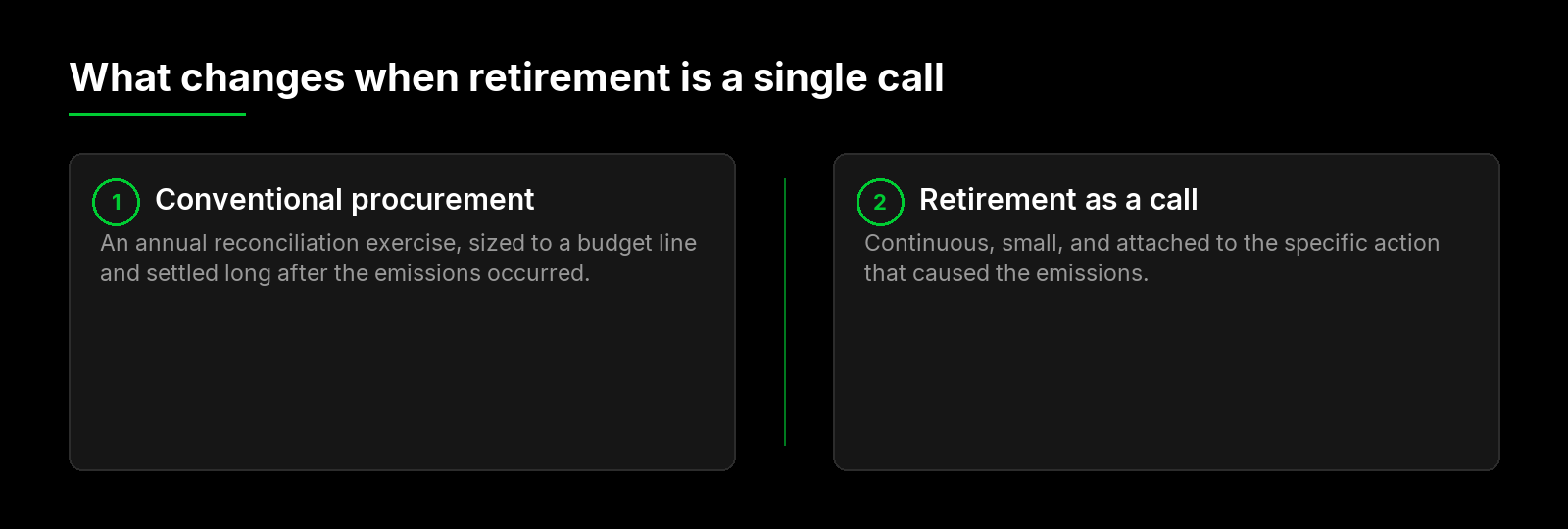
Six hundred retirements averaging a third of a tonne would have been challenging under conventional carbon procurement, where the administrative cost of a transaction barely changes between one tonne and ten thousand. That fixed cost is why compensation has historically been an annual reconciliation exercise, sized to a budget line and settled long after the emissions occurred. When retirement becomes a single, instant call, the marginal cost of the six-hundred-and-first retirement is a transaction rather than a process, and a different shape of demand becomes viable: continuous, small, and attached to the specific action that caused the emissions in the first place.
This is additive to how the voluntary carbon market already works, not a replacement for it. The credits are the same registry-issued credits, the projects are the same projects, and the verification standards are unchanged. What changes is the interface between demand and settlement, and therefore which applications can plausibly generate demand at all. Standardising credits into carbon classes with shared execution terms is what allows a piece of software to ask for a category at market rather than negotiate a bespoke bilateral trade, and pairing that liquidity with a payment standard the whole web already speaks is what allows the request to come from software in the first place. Neither layer does much alone.
A foundation, not a finish line
Vealth is an example of a team building with Klima's tools, and one of the objectives of the hackathon is to create a group of developers who know how to. Many teams building in carbon do not have fluency in Web3, and vice versa; this knowledge gap is something that Klima intends to bridge. Developing working integrations against the x402 endpoint and the Retirement Aggregator can help integrate onchain solutions with the existing carbon market.
Our congratulations to EcoWealth. The endpoint remains live and free to call on Base, the aggregator remains open to direct integration, and the case studies from this cohort will be published on the Klima Labs site as each team's work is documented. We invite developers, carbon buyers, and agent-platform builders to build the next one, and to tell us what the tooling should do that it does not do yet.
For other builders looking to build with onchain tools within carbon markets, and who may be looking for technical support or collaboration opportunities, reach out to info@klimaprotocol.com.
Frequently asked questions
Who won the Klima Community Hackathon?
Vealth, built by EcoWealth. Its public beneficiary record on Carbonmark shows 199.04 tonnes retired across 605 separate retirement transactions, and that record was still growing several days after the competition's retirement cutoff.
What is Vealth?
A marketplace for provable ecological work. It turns real-world ecological work — restoring habitat, improving water systems, planting shade trees, increasing building efficiency — into priced, provable tasks, and attaches a verified carbon retirement to each one as an environmental receipt generated by completed work rather than as the reason the work exists. Retirements settle through Klima Protocol's Retirement Aggregator on Base, reached over the x402 endpoint.
How can developers reach Klima Protocol's retirement infrastructure?
By three routes. The x402 endpoint exposes six actions at a single multiplexed URL in front of the Retirement Aggregator, with free reads and a non-custodial design that never holds funds. Teams already working onchain can call the Retirement Aggregator contract on Base directly, passing a RetireDetails struct naming the beneficiary. Teams building off-chain products that collect payment through conventional rails can use the Carbonmark app, which handles retirement without code.
Can software retire carbon without holding ETH for gas?
Yes, through the x402 endpoint's relay path. The caller signs one standard token authorisation covering the retirement cost, the x402 fee, and a gas reimbursement, all slippage-buffered; a Klima executor submits the transaction and is reimbursed from that signed budget, with unused buffer refunded in the same transaction. The signer needs a USDC or kVCM balance and nothing else — no ETH for gas, no prior approvals, and no Base account to fund and monitor.
Why does retirement granularity matter?
Under conventional carbon procurement the administrative cost of a transaction barely changes between one tonne and ten thousand, which is why compensation has historically been an annual reconciliation exercise settled long after the emissions occurred. When retirement becomes a single instant call, the marginal cost of the six-hundred-and-first retirement is a transaction rather than a process, making a different shape of demand viable: continuous, small, and attached to the specific action that caused the emissions.
Does onchain retirement replace the existing voluntary carbon market?
No, it is additive. The credits are the same registry-issued credits, the projects are the same projects, and the verification standards are unchanged. What changes is the interface between demand and settlement, and therefore which applications can plausibly generate demand at all.